
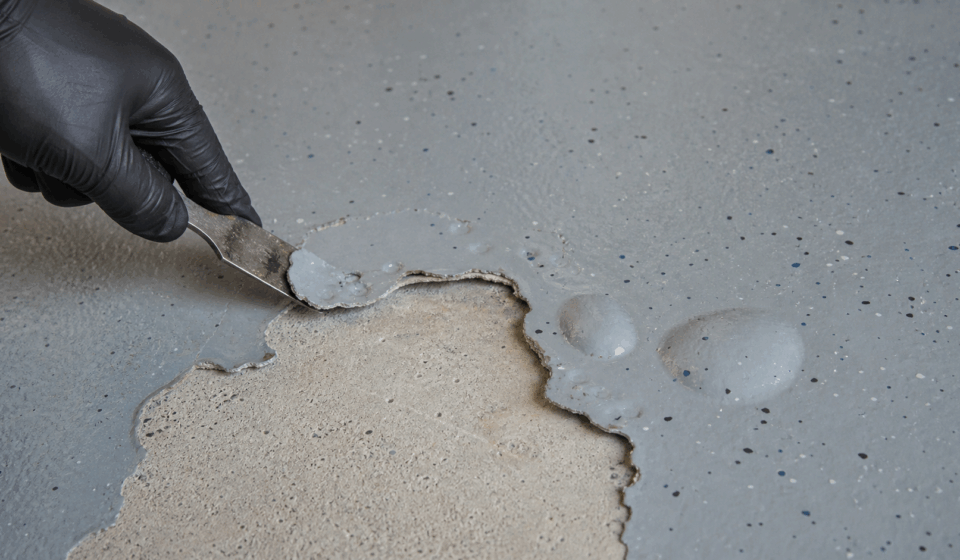

Most floor coating failures are not random. Peeling, bubbles, fisheyes, uneven gloss, and soft spots usually point to a problem with moisture, contamination, preparation, mixing, application conditions, or recoat timing. Recognizing the pattern helps determine whether a small repair is reasonable or the failed material must be removed.
Table Of Content
Peeling or delamination
Peeling often means the coating never developed a reliable bond. The slab may have been too smooth, dusty, oily, weak, or covered with an incompatible sealer. Moisture vapor can also push a film away from concrete. Prevention starts with inspection, moisture testing, mechanical profiling, careful vacuuming, and a primer approved for the substrate.
Bubbles and blisters
Air can escape from porous concrete while a coating cures, creating pinholes or bubbles. Rising slab temperature makes outgassing more likely. Moisture vapor or trapped solvent can produce larger blisters. Apply the correct primer, follow coverage limits, and coat when slab temperature is stable or falling if the product guidance recommends it. Never exceed the stated thickness in an attempt to hide defects.
Fisheyes and craters
Round craters that pull away from a center point suggest surface contamination. Oil, silicone, wax, tire dressing, soap, or airborne spray products can interfere with wetting. Deep cleaning and removal of contaminated concrete may be required. Keep lubricants, polishes, and silicone products away from the preparation and mixing area.
Soft or sticky areas
Two-part coatings need exact proportioning and complete mixing. Material scraped from the side or bottom of a mixing container may be unmixed and remain soft. Measure components accurately, mix for the specified time, and consider transferring the blend to a clean second container before a brief final mix. Observe pot life; material can become unusable even if it still appears liquid.
Roller marks and color variation
Uneven thickness, dry edges, poor batch control, or stopping mid-section can create visible bands. Keep a wet edge, divide the floor into measured areas, and mix complete kits whenever possible. Use consistent rollers and application direction. Combine colored material from different lot numbers when the manufacturer recommends boxing batches for uniformity.
Cloudy or milky topcoat
High humidity, condensation, water exposure, or an incompatible recoat window may affect clarity. Check air temperature, slab temperature, relative humidity, and dew point before application. Protect the curing floor from rain, washing, open doors, and overnight condensation. Some rapid-cure systems are especially sensitive to timing and environmental conditions.
Premature scratching or tire pickup
The surface may feel dry before it has reached full cure. Heavy items, turning tires, hot tires, or aggressive cleaning can damage a young coating. Follow separate return-to-service times for foot traffic, replacing equipment, and vehicle traffic. In cool weather, curing may take longer than the minimum time on a label.
Cracks showing through
Coatings do not stop structural movement. Static cracks can often be repaired before installation, but control joints and active cracks need a flexible or engineered detail. Ask whether the goal is to disguise a crack, reduce contamination, or accommodate movement; each requires a different approach.
When to repair and when to remove
Spot repair can work when damage is isolated and the surrounding coating is firmly bonded. Widespread peeling, moisture-related blistering, or soft material usually requires removal back to a stable layer or to concrete. Before recoating, identify the cause. Installing another layer over the same unresolved problem only delays the next failure.
Prevention is a process, not a single product. Document moisture readings, preparation, batch numbers, temperatures, mix times, coverage, and recoat intervals. Those records improve consistency and make any future troubleshooting far easier.